
Named Best Insurance Innovation at the Finder Innovation Awards 2026

Industry Insights
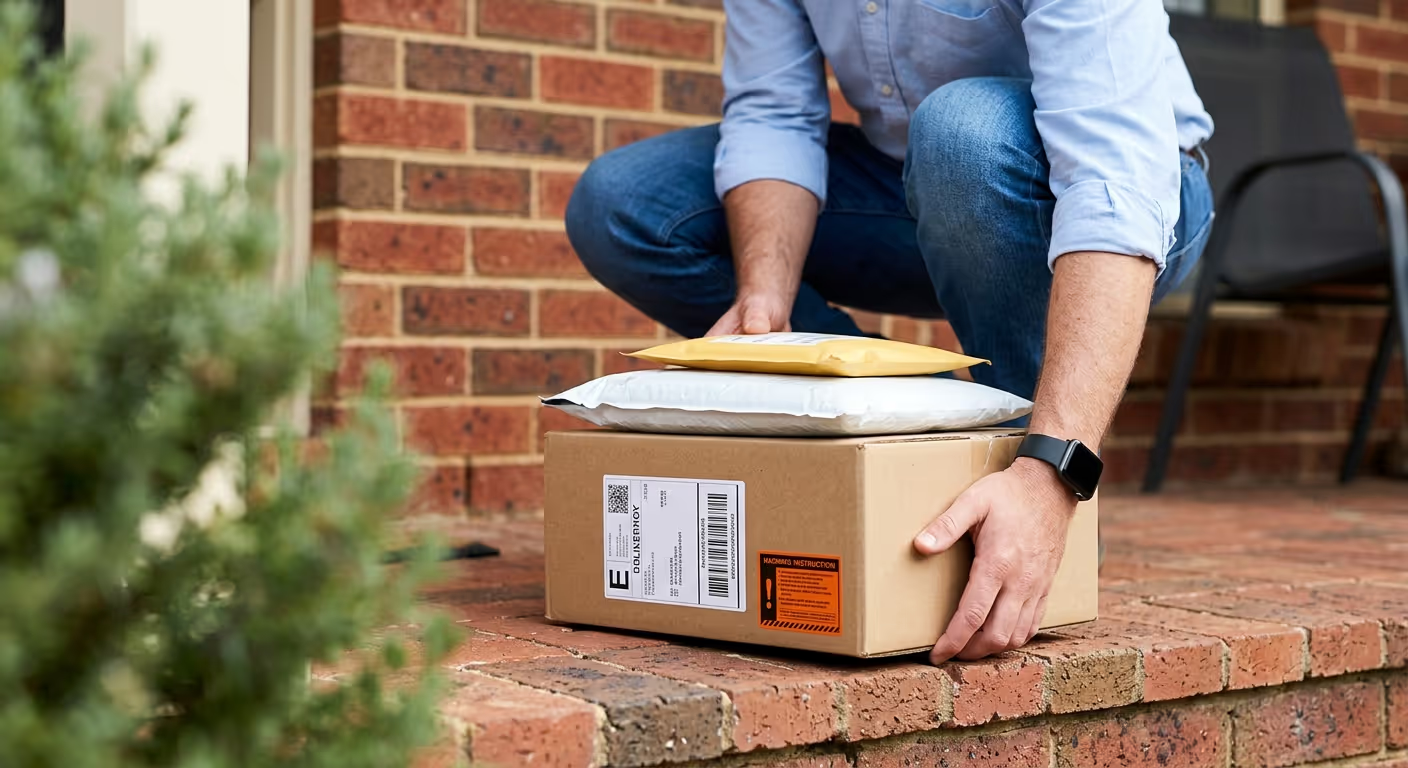

Authority to Leave insurance can be messy. One tick box can decide whether a freight claim is a transit loss or a post-delivery problem. For shippers, carriers, and platforms, that distinction matters more than the label "ATL".
FreightInsure writes embedded goods-in-transit insurance for Australian businesses, underwritten by Assetinsure Pty Ltd (ABN 65 066 463 803; AFSL 488403) and HDI Global Specialty SE (ABN 58 129 395 544; AFSL 458776). This guide explains how ATL affects cover, when a claim may be declined, and when an ATL delivery may still be questioned.
"Authority to Leave" is permission for a courier or carrier to complete a delivery without obtaining a signature. The receiver authorises the driver to leave goods at a nominated location, and the driver records that location as the point of delivery.
ATL can appear on a consignment note, inside a freight platform, or as a standing instruction with the carrier. It is common with Australia Post, couriers, and freight companies moving cartons, pallets, crates, and machinery.
A receiver might ask a driver to "leave behind side gate" or "place under awning near roller door". That sounds simple. It affects when the insurance policy treats goods as delivered, which is the pivot point for any insurance claim.
ATL changes the risk profile for theft, loss, accidental damage, and weather damage once goods are left. Opting into ATL shifts financial risk away from the carrier and onto the receiver, and it can affect both transit insurance and home and contents insurance policies.
In FreightInsure's goods-in-transit insurance policies, ATL can be a valid form of delivery when it is properly authorised and reasonably executed. Insurance cover is tied to the coverage period in the insurance contract, not to ATL in isolation.
Under most transport and general insurance policies, cover ends at delivery, whether signed or ATL. The cover does not continue until the customer notices the item. Read the insurance policy, the policy's terms, and the product disclosure statement before choosing ATL.
Businesses should also check freight insurance, comprehensive transit insurance, and business property insurance products for ATL wording and exclusions. Insurance claims are assessed against the policy contract, the facts of the loss, and the available evidence.
Once an endorsed ATL delivery is completed safely, later financial loss is usually not covered. It is treated much like a signed delivery.
In FreightInsure's policy, safe ATL delivery is the end of the coverage period, and loss occurring after delivery is generally outside the scope of transit cover. That does not mean every ATL claim is automatically declined. The trigger is post-delivery loss after a safe ATL, not the presence of ATL in the booking.
Once an item is marked as delivered under an ATL agreement, the carrier's legal responsibility for transit ends, and claims for transit loss or theft are generally not valid.
ATL does not automatically void freight insurance. The real question is whether the goods were ever delivered in a reasonable sense.
FreightInsure assesses each claim on its facts, including whether the ATL instruction was executed safely. A carton of laptops left on top of a letterbox on a busy road at 3:30pm is not a triumph of logistics. If stolen within an hour, the placement may be the relevant issue, not the ATL itself.
Another example: a case of premium wine left in full sun on an exposed driveway on a 38°C Sydney day in January. If it perishes within hours, the delivery decision created a foreseeable risk.
Assessment usually considers:
In disputed cases, customers can use the insurer's internal dispute resolution process and then escalate to the Australian Financial Complaints Authority. Each claim is assessed on its facts.
The coverage period is the time when the insured freight is actually in transit. Most policies define it as starting when goods are handed to the carrier and ending when delivery is completed.
For FreightInsure, endorsed ATL is treated as functionally equivalent to signed delivery when executed safely. The logic is straightforward:
Example timeline:
In that example, the claim is usually outside insured transit risk. Businesses should review how their freight contract and insurance contracts define delivery and risk transfer.
A safe place is judged by what a reasonable person would consider secure and weather-protected at the time of delivery.
Better ATL locations include:
Poor ATL locations include open apartment lobbies, shared foyers with public access, exposed driveways in heavy rain, or anywhere the goods are visible from the footpath. Packages exposed on a porch generally do not meet the security criterion that most insurance providers expect.
For home contents insurance to cover theft, insurers typically require evidence of forcible entry into a secure area. Standard home and contents policies often do not cover stolen packages from a doorstep if ATL was consented to at delivery.
Most ATL content frames the risk as the customer's to wear. Tick the box, accept the loss.
That framing misses where ATL decisions actually go wrong. Most ATL disputes do not happen because a customer made a bad choice. They happen because the booking flow surfaced ATL as a default rather than a deliberate choice, because the driver received an ambiguous instruction, or because nobody captured evidence at the point of drop.
For FreightInsure, ATL sits inside the same booking flow as the cover itself. That means carriers and platforms are the ones designing the decision. Three patterns make ATL claims more likely to land in dispute:
For shippers, this is the practical takeaway: if a carrier you ship with treats ATL as the default and captures little evidence, the outcome of a loss is not really a coverage question. It is a documentation question that has already been decided against you.
Good ATL rules reduce disputes, claims, legal costs, and awkward phone calls.
Use these controls:
High-value electronics, jewellery, wine, and medical equipment usually need tighter controls. A post office, secure dock, or staffed reception may be safer than a doorstep.
Clear ATL settings reduce internal dispute resolution cases and complaints to the Australian Financial Complaints Authority over alleged mishandled deliveries.
If an insurer declines an ATL-related insurance claim, ask the insurance company for written reasons. The response should refer to the insurance policy clauses, evidence, and delivery facts relied on. You can lodge a claim with FreightInsure online if your claim relates to FreightInsure cover.
Then make a formal complaint in writing. Under ASIC Regulatory Guide 271 and the General Insurance Code of Practice, an insurer's internal dispute resolution response should be provided within 30 calendar days. If the insurer does not resolve your complaint within that window, you can escalate the issue to the Australian Financial Complaints Authority, which provides free and independent dispute resolution services.
AFCA contact details: afca.org.au or 1800 931 678. You generally have two years from your insurer's IDR response to lodge with AFCA (other time limits may apply).
Claim timing also matters under the General Insurance Code of Practice 2020:
For step-by-step guidance on what to do if freight is lost or damaged, see how to make a freight claim.
In stolen package cases, file a report with local police and obtain a reference number for insurance disputes. Keep delivery photos, ATL instructions, POD data, emails, and platform logs.
ASIC and APRA (the Australian Prudential Regulation Authority) regulate the insurance industry but do not decide individual compensation disputes. Unfair contract terms protections have applied to insurance contracts entered into or renewed from 5 April 2021.
ATL can affect more than freight cover. Once freight is safely delivered under ATL, later theft or damage may fall to the receiver's own property, stock, or contents insurance.
Each policy has its own definition of when cover begins and ends. A claim that falls outside transit cover may sit inside a property or stock policy, or it may sit in the gap between them. The gap is where ATL disputes tend to live.
Speak with an insurance adviser about how property, stock, transit, and business interruption policies meet at delivery. Clear coordination between carrier, shipper, and receiver reduces gaps in cover.
ATL is not automatically covered or not covered. The outcome turns on how the delivery was executed, what the contract says, and what evidence exists.
FreightInsure helps logistics businesses set sensible ATL rules, embed per-shipment insurance inside the booking flow, and assess claims quickly. We offer pay-as-you-go freight protection with per-shipment cover up to AUD 100,000, domestic or international, simple online claims, and no excess on eligible policies.
Review your ATL settings today. If your business ships freight often, Book a Demo or explore FreightInsure's solutions for transport companies, shippers, and platforms.
.avif)
Industry Insights
.avif)
Company News
Industry Insights