
Named Best Insurance Innovation at the Finder Innovation Awards 2026

Company News
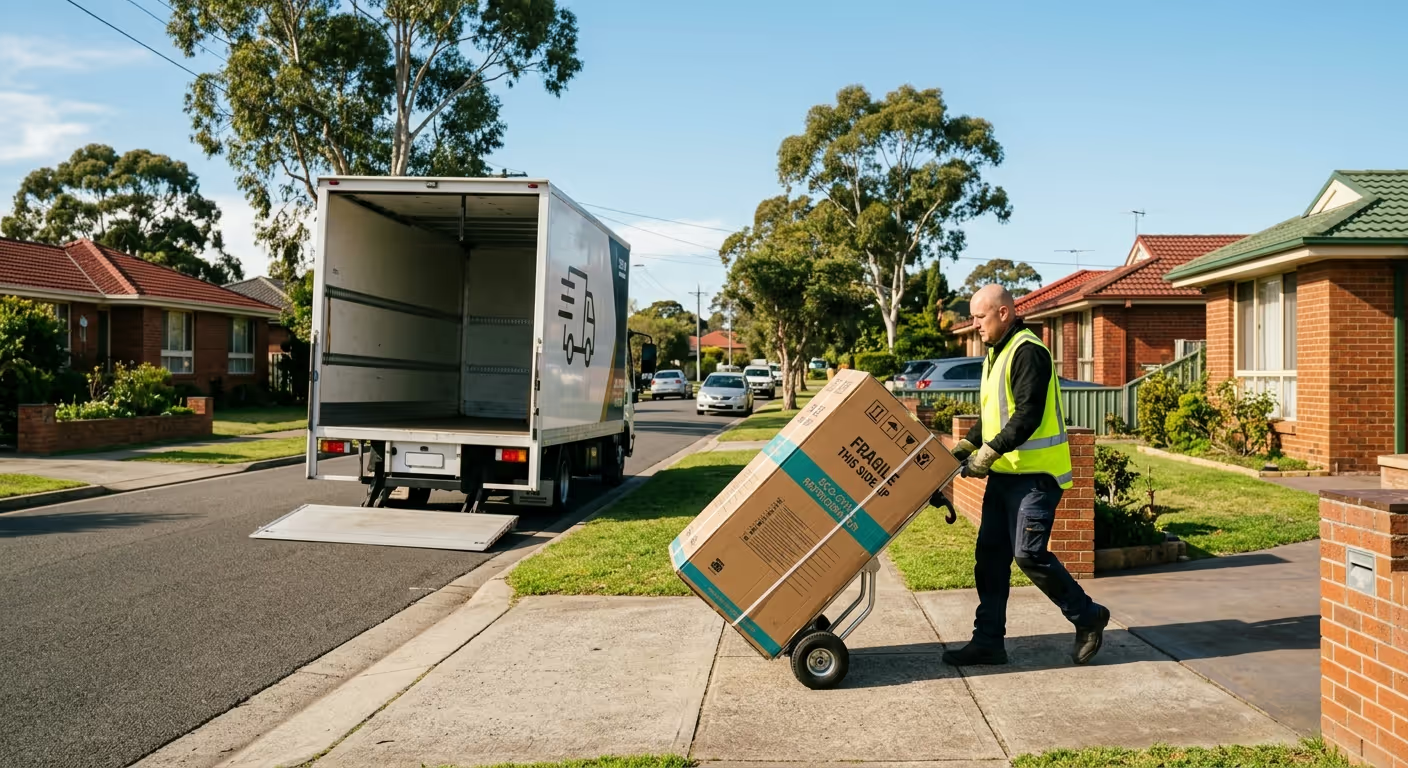

Large and heavy items are harder to ship than cartons or satchels. They need forklifts, tail-lifts, two-person teams and extra vehicle space. They are more likely to get scratched during loading, crushed by stacking, or dropped during handoff. Standard protective systems built for uniform parcels do not work well for a 2.4 m flat-pack wardrobe or a 120 kg treadmill.
Most damage on bulky freight is not a total loss. It is the medium-sized hit. An $800 scratched dining table. A $2,500 damaged treadmill. These sit in what we call the uninsurable middle: too big for a carrier to absorb under its liability cap, too small to clear the excess on a marine policy. Bulky freight lands in this band more than any other category, because its damage is frequent and moderate rather than rare and catastrophic. That is the gap this article is about, and the gap FreightInsure is built to close.
This article is written for Australian businesses sending big and bulky goods locally and interstate in 2026, whether the lane is Sydney to Brisbane, Melbourne to Perth, or Brisbane to Townsville. It covers what counts as heavy, large or oversized freight, how to pack and plan consignments, how to choose the right carrier or courier, and how to protect shipments financially.
FreightInsure is an embedded, per-consignment goods-in-transit insurance option purpose-built for this category. It fills the protection gap that carrier liability and marine insurance leave open on large and heavy freight.
There is no single official classification in Australia that defines "heavy," "bulky," or "oversized" freight. Thresholds vary across carriers and service types. But common working rules help with planning and pricing.
Parcels over 23 kg are classified as heavy shipments across most of the industry. Loads above roughly 16 to 20 kg warrant a risk assessment, and loads above 55 kg almost always need mechanical assistance. Many carriers flag items in the 25 to 32 kg range as needing two-person lifts or mechanical aids. Standard parcel services often refuse items over 22 kg entirely.
Bulky items are freight where shape and dimensions, not just weight, drive cost and handling complexity. Think a 2.4 m flat-pack wardrobe, a 3 m stone benchtop, or an 80 kg sofa that is awkward to manoeuvre even though it is a single unit.
A large parcel, in practical terms, is anything that needs large boxes, custom crates, or must be moved by trolley, tail-lift or forklift rather than by one person. Shipments under 70 kg can often travel without a pallet, but anything heavier typically requires one.
Goods are often considered oversized when they cannot fit on the Australian standard pallet footprint (1165 mm x 1165 mm) or when unit weight approaches or exceeds 500 kg. Items exceeding 2.4 x 1.2 x 1.8 m may incur extra charges. Oversized items over 500 kg need custom shipping solutions, such as industrial equipment or commercial refrigeration units. Shippers should always check service-specific limits and surcharges. Many carriers cap palletised freight around 1.2 m x 1.2 m x 1.8 m and 1,000 kg, with items outside those limits moving into a different, more expensive service class.
Home and furniture
Fitness
Trade and construction
Industrial and commercial
All of these are typically considered large and heavy items and often trigger special handling rules, different courier service options, and higher financial risk if damaged in transit.
Most cost blowouts and delays start with bad data. Wrong weight, inaccurate dimensions, or unclear access details at the pickup or delivery location.
Measuring and weighing. Once the item is packed, measure length, width and height at the widest points, including any pallet or crate. Weigh the total load including all packaging materials. Simple warehouse tools like tape measures and floor or pallet scales are enough. Accurate measurements of dimensions and weight prevent excessive charges.
Dead weight vs volumetric weight. Freight costs are often based on dimensional weight, not actual weight. Carriers calculate volumetric weight by multiplying length x width x height and applying a conversion factor. A common factor of 333 kg per cubic metre applies to Australian general road freight. Overhangs on pallets and irregular shapes inflate cubic weight, so parcel weighing alone is not enough.
Interstate vs metro vs remote. Australian freight networks treat metro, regional and remote interstate delivery differently. Sydney to Brisbane and Sydney to Melbourne lanes have frequent linehaul runs, competitive pricing and flexible options for heavy items. Melbourne to Perth involves longer transit, more depot transfers and higher surcharges. Routes to Darwin or remote postcodes often add fuel levies, access fees and time.
Service constraints. Common limits include maximum weight per piece (e.g. 70 kg per carton, 1,000 kg per pallet), maximum length of 2.4 to 3.0 m, and rules on non-stackable freight. Items over 70 kg should be palletised or crated for safe shipping. Shippers moving large heavy consignments like 250 kg machinery should confirm tail-lift, crane or forklift availability at both ends, and factor equipment requirements into quoting and scheduling.
Most real-world damage claims on bulky freight are preventable with better packing and load preparation. Shipping costs can increase due to insufficient packaging. Investing in packaging is both a quality and risk-management decision.
Cartons and boxes. To pack large items in large boxes, use new double-walled or triple-walled corrugated cardboard. Add corner protectors and void fill for things like AV equipment, office chairs and boxed appliances. Disassembling large items into smaller pieces can prevent damage during transit when practical.
When to palletise. Shipments over 70 kg may require a pallet for transport. Move from boxes to palletising when you have multiple heavy cartons over 23 kg each, or a single heavy item like a 90 kg commercial oven. Large items typically require palletisation for shipping. Pallets help avoid additional shipping costs for heavy items by enabling forklift handling and reducing manual contact.
Pallet basics. Use sound timber or plastic pallets with no missing boards. Centre the weight to avoid tipping during forklift handling. Secure loads with industrial strapping and stretch film. Corner angles help with stability on stacked loads.
Crating. For oversized or highly fragile items, such as stone benchtops, glass cabinets, artworks and high-end machinery, use timber frames with internal bracing and foam padding on all contact surfaces.
Labelling. Label boxes over 23 kg as "HEAVY" for safety. Add "FRAGILE" labels and orientation arrows where relevant. Include consignment numbers and contact details on at least two sides plus the top. Clear labelling on packages assists handlers with fragile or heavy items.
No single carrier or courier service can handle every large and heavy item well, especially at national scale across Australia.
Common modes. For domestic bulky freight, the main options are road express, general road freight, pallet networks, specialist bulky carriers and dedicated vehicles for urgent moves. Less-Than-Truckload (LTL) freight suits shipments too large for a parcel service but too small to fill a truck. It is cost-effective because you pay for the truck space you occupy, not the full truck.
When courier works. Parcel-based courier service can still work for shipments under 70 kg with good packaging. Above that, a pallet or skid is safer and more efficient.
Specialist services. Large heavy consignments often need tail lifted goods delivery, two-person teams, white-glove in-home placement, assembly and rubbish removal. Specialised carriers are needed for oversized shipments to avoid damage or rejection.
Carrier selection criteria. Look beyond headline pricing. Assess damage performance on bulky items, coverage of key postcodes, service reliability, and clarity of surcharges on oversized freight. Test carriers on typical bulky lanes over a defined period of three months and track delivery times, damages and total landed cost per consignment.
Sydney to Brisbane and Sydney to Melbourne lanes support frequent linehaul movements and can handle heavy items more flexibly than many regional routes. FreightInsure claims data shows inner Melbourne sees 45% more claim frequency than the national average, and 10% of corridors account for roughly 31% of recorded claims.
Melbourne to Perth and east-coast to WA routes involve longer transit times, more handling points and higher costs for bulky items and pallets. Large and heavy items sent to North Queensland, Tasmania or the NT (Townsville, Hobart, Darwin) may require multi-leg routing and careful timing for delivery to ports or depots. Shippers using sea freight for WA or Tasmania legs should allow extra lead time and confirm cut-off schedules for interstate delivery of large boxes, pallets and oversized freight.
Most Australian carriers operate on a "not a common carrier" basis. This removes the common-law strict liability that would otherwise make them responsible for loss or damage. Their liability is then only whatever their consignment note and transport terms allow. That is typically a low flat cap, broad exclusions, or no liability at all, with short notification windows of 24 to 72 hours.
This is especially painful for bulky items like furniture and machinery, where a single incident can damage a few thousand dollars of goods in one consignment. Many businesses assume their annual marine or property policy will cover these losses. But traditional marine insurance often carries an excess of $1,000 to $2,000 or more per claim.
Typical bulky-goods claims, a $1,200 dented fridge, an $1,800 damaged office desk set, a $900 cracked vanity, often fall below or around that excess. The claim is not worth submitting. FreightInsure's own data estimates that roughly 1% of domestic freight value is lost or damaged annually in Australia, translating to about AUD 2 billion quietly absorbed by businesses. This leaves a protection gap exactly in the range where most bulky freight damage actually occurs.
This is why bulky freight is the worst-hit category for the uninsurable middle. The damage is rarely catastrophic and rarely trivial. It clusters in the few-hundred to few-thousand-dollar band, exactly where carrier liability stops and marine cover has not started. FreightInsure's no-excess, named-perils cover attaches in that band per consignment, so a valid claim on a covered event pays from the first dollar instead of disappearing under a deductible.
FreightInsure offers per-consignment goods-in-transit insurance that can be embedded into freight bookings or purchased directly by the shipper. There is no need for a large annual premium.
Cover is for named perils only. Protection attaches for specific Covered Events such as vehicle collision, rollover, fire, theft and other listed transit incidents. It does not cover every possible cause of loss. Direct weather events on exposed freight, such as storm or cyclone damage to outdoor-stored goods, are not covered unless specifically included in the policy wording. Shippers should check the Product Disclosure Statement.
FreightInsure policies have no excess on covered events. Valid claims for a $700 damaged large parcel or a $2,500 pallet of furniture are not eroded by a large deductible. Current indicative limits are up to AUD 100,000 for domestic transit per consignment and up to AUD 50,000 for international shipments. That is sufficient for most large items and pallets shipped across Australia and overseas.
FreightInsure complements existing annual marine policies. It handles the day-to-day bulky freight incidents that would otherwise sit below a marine excess and get absorbed as silent margin loss.
FreightInsure can be integrated into booking portals, transport management systems and freight platforms so insurance is offered at the point of booking each consignment. Shippers can arrange cover selectively: all orders over a set value, all oversized consignments, or all shipments to particular high-risk postcodes.
Shippers must declare the value of goods in each insured shipment. Under-declaring can reduce claim payouts pro rata under the policy wording. For damaged bulky consignments, the claim process involves immediate photos at delivery, notations on delivery dockets, prompt notification, and submission through an online claims portal.
Carriers, 3PLs and freight platforms can embed FreightInsure into their booking flows to offer per-consignment cover for large and heavy freight automatically. The platform integration is designed to save time and reduce the administrative load on your team.
Shippers who book directly with transport providers can also buy cover per shipment through FreightInsure without needing a complex marine policy. A practical starting point: pilot FreightInsure across all large boxes and pallets on a single lane, say Melbourne to Brisbane, for 60 to 90 days. Track the impact on financial leakage from damage. Collect the data and let it inform your next move.
.avif)
Industry Insights
.avif)
Company News
Industry Insights