
Named Best Insurance Innovation at the Finder Innovation Awards 2026

Industry Insights
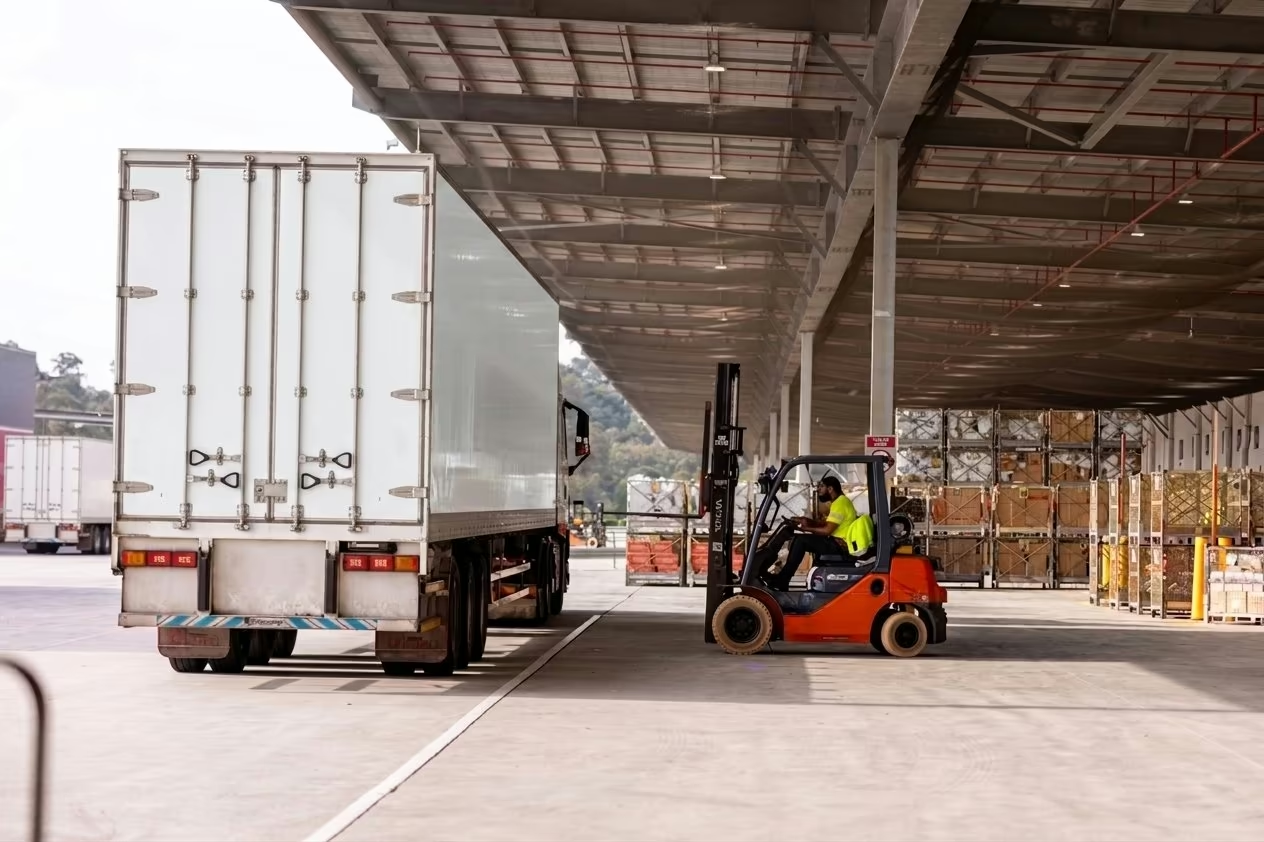

Every day in Australia, freight goes missing. The broker points to the carrier. The carrier points to the port. The port points to the subcontractor. And the shipper - who just wants to know where their goods are - gets nothing. No compensation. No accountability. No clear answer.
This isn't a one-off. It's a structural problem baked into how commercial freight works - and it plays out across thousands of shipments every week. Different goods. Different values. Same outcome.
This is the part of the conversation that gets missed.
When a freight carrier declines to compensate a shipper for lost or damaged goods, it's rarely malicious. It's economic. Freight margins are tight - often razor thin - and they don't allow for the financial burden of absorbing freight claims at scale. Most carriers limit their liability through their standard conditions of carriage for precisely this reason.
That's not a scandal. It's a commercial reality.
The problem is that shippers don't know this until they need to make a claim. They hand over their goods assuming someone along the chain is responsible for getting them there safely. When something goes wrong, they discover that assumption was wrong - and by then it's too late.
The ABC story involved a broker, a transport company, international shipping lines, and port workers employed by none of the above. That's not unusual. Most commercial freight in Australia moves through networks like this.
Here's what happens when goods go missing in a multi-carrier chain: the shipper sees their goods scanned into a network and never scanned out. The carrier at one end can see their leg. The subcarrier at the next leg uses different technology - different QR codes, different labels, incompatible tracking systems. Visibility disappears the moment goods cross from one network to another.
So when everyone convenes to work out what happened, nobody actually knows. And because nobody knows, everyone defaults to their standard terms. All care. No responsibility.
The irony is that the more complex the journey - the more legs, the more handoffs - the more things can go wrong, and the less accountability exists at any single point. Carriers who move freight end-to-end have every reason to take care of it. Carriers who are one link in a chain of five have considerably less.
Here's where it gets commercially uncomfortable.
When a claim lands on a carrier's desk, they face the same decision every time: pay out to protect the relationship, or decline to protect the margin.
Neither option is good. Pay out, and you're absorbing a loss you can't afford, setting a precedent, and creating an operational burden - because somebody in your business has to assess, manage and process that claim. Decline, and you risk losing a customer who will tell others. In a market where fuel levies are already straining shipper relationships, that reputational risk compounds - fast.
Most carriers are navigating this tension constantly. What they often wish, when a claim lands, is that it was somebody else's problem. Financially and operationally.
Believe it or not, that wish is achievable.
The fundamental design of embedded freight insurance solves the multi-carrier accountability problem at its root.
When a shipper holds their own insurance policy - embedded at the point of booking - the question of which carrier was responsible at which point in the journey becomes completely irrelevant. FreightInsure covers the consignment end-to-end*, from pickup to delivery, regardless of how many carriers, subcarriers or subcontractors handled it in between. There's no chain of responsibility to unravel. There's no blame game. There's a clear party - the insurer - whose job it is to assess and pay the claim.
For carriers, this matters in three ways.
The financial risk of claims disappears from the balance sheet entirely. The operational burden - the staff costs, the assessments, the disputes, the delays - goes with it. And the customer, rather than being caught in a run around between carriers and police and port authorities, gets a solution. Quickly. Without the carrier being the villain in the story.
Carriers who embed insurance into their offering aren't just providing a product. They're removing the conditions that create bad customer experiences and earning revenue at the same time. It's a no brainer.
Freight carriers are under more margin pressure right now than they've been in years. Fuel costs are up. Surcharges are straining customer relationships. The last thing any carrier needs is a wave of uninsured claims landing on their desk at the same time.
But here's the counterintuitive opportunity in that pressure: carriers who can offer their customers genuine protection - through embedded insurance - are offering something that has nothing to do with price. In a market where everyone is competing on rate, that differentiation matters.
A customer who knows their freight is protected, and who has seen a claim resolved quickly and fairly, is a customer who stays. Not because they're loyal in the abstract sense, but because switching carriers mean losing that protection and starting again.
The carriers building that stickiness today will be in a very different position when the pressure eases. The others will still be managing the blame game - one unanswered claim at a time.
.avif)
Company News
Industry Insights
Company News